
PIP · Personal Independence Payment
PIP assessment coming up? Go in prepared, with your own notes.
The PIP Assessment Preparation Workbook takes you through your PIP assessment before, during and after: a worksheet for each of the twelve activities, the hard moments scripted, and how to check the report afterwards. £12. A PDF by email, yours to keep.
The assessment is short. Your notes make it count.
A PIP assessment is one appointment, by phone, video or in person, with a healthcare professional working for the DWP. What they write in the report, the PA4, is what the decision maker reads.
And the assessor isn’t deciding whether you’re unwell. They’re scoring twelve activities, using a rule you’re never told: you count as unable to do something if you can’t do it safely, to an acceptable standard, repeatedly and in a reasonable time, on more than half the days. Every worksheet is built around that rule.
Start as soon as your appointment letter arrives. Fill it in over a week or so, twenty minutes at a time if you need to, ideally with someone who knows your days.
Four things that help on the day.
Written from the PIP rules, for you to fill in and take with you.
A worksheet for every activity
All twelve, each with the question the assessor is really asking, the trap that catches people, and a box for your answer.
The four-part answer
What you can’t do, why, what happened, and how often and who helps. Plus the three words that lose points: fine, manage, sometimes.
The summary at the end
Most assessors read back a summary. It’s the draft of your report, and your last chance to correct it.
The report, decoded
Your PA4 section by section, what its phrases really mean, and the eight errors that appear again and again.
The same question. Two very different answers.
Every assessor asks something like this. What you say is what goes in the report.
“Can you prepare a meal?”
“Yes, I can cook.”
What the report records: can prepare food. Nothing about the stool, the help or the bad days.
“On a good day, with a perching stool and someone else lifting the pan. That’s two days a week. The other five I don’t cook.”
The aid, the helper and how often: the parts that score.
See the pages before you buy.
Three of the 28 pages, exactly as you’ll get them. Tap a page to see it full size.
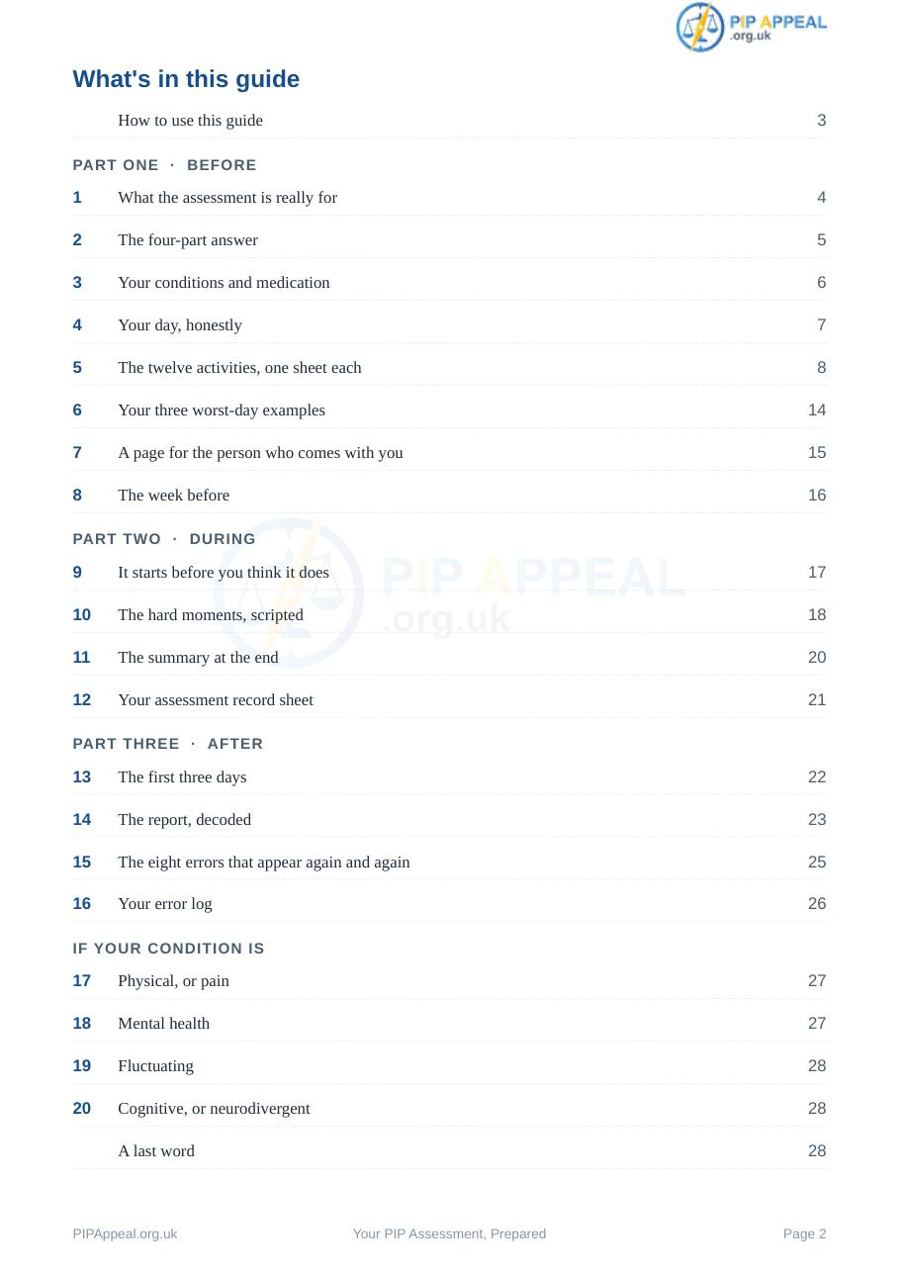
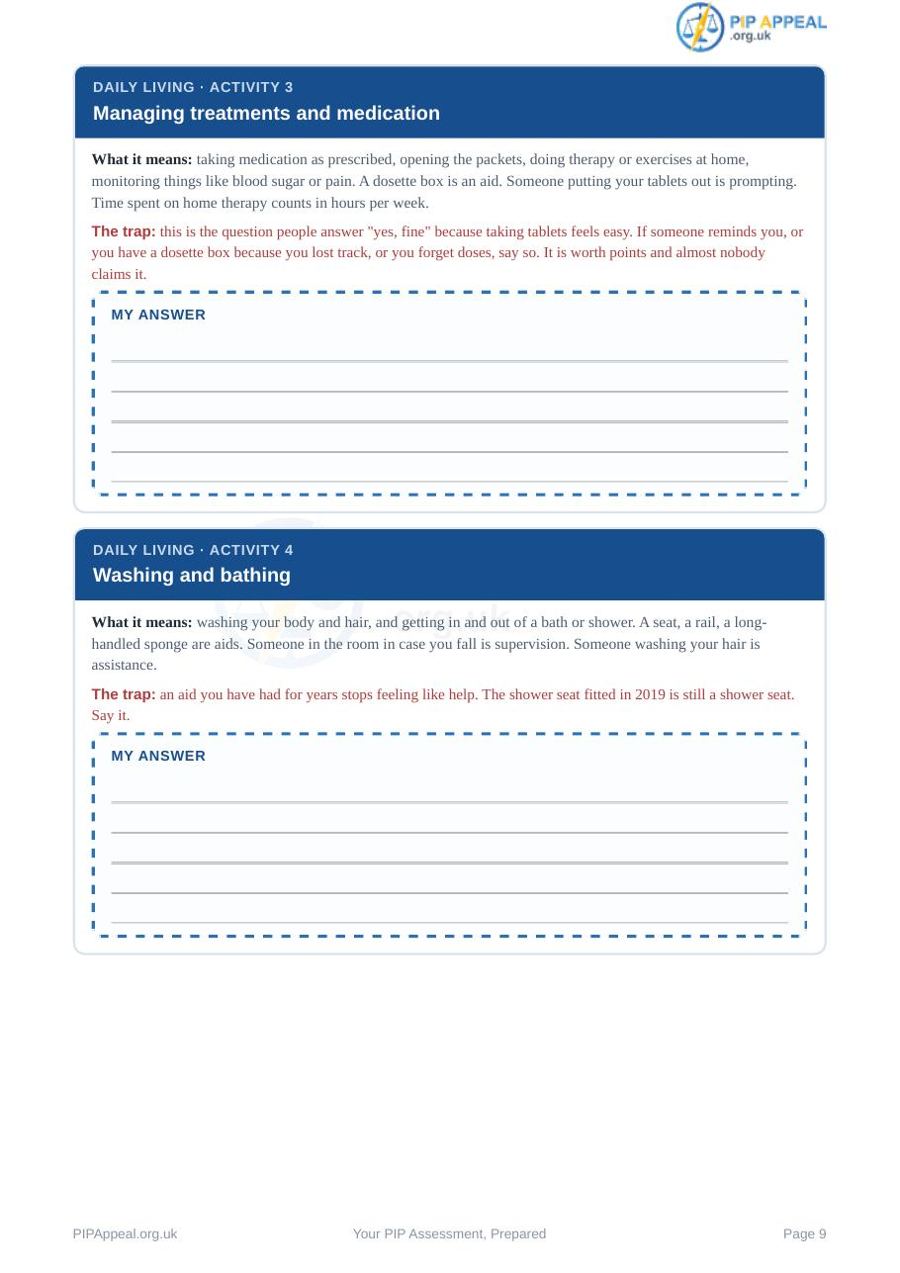
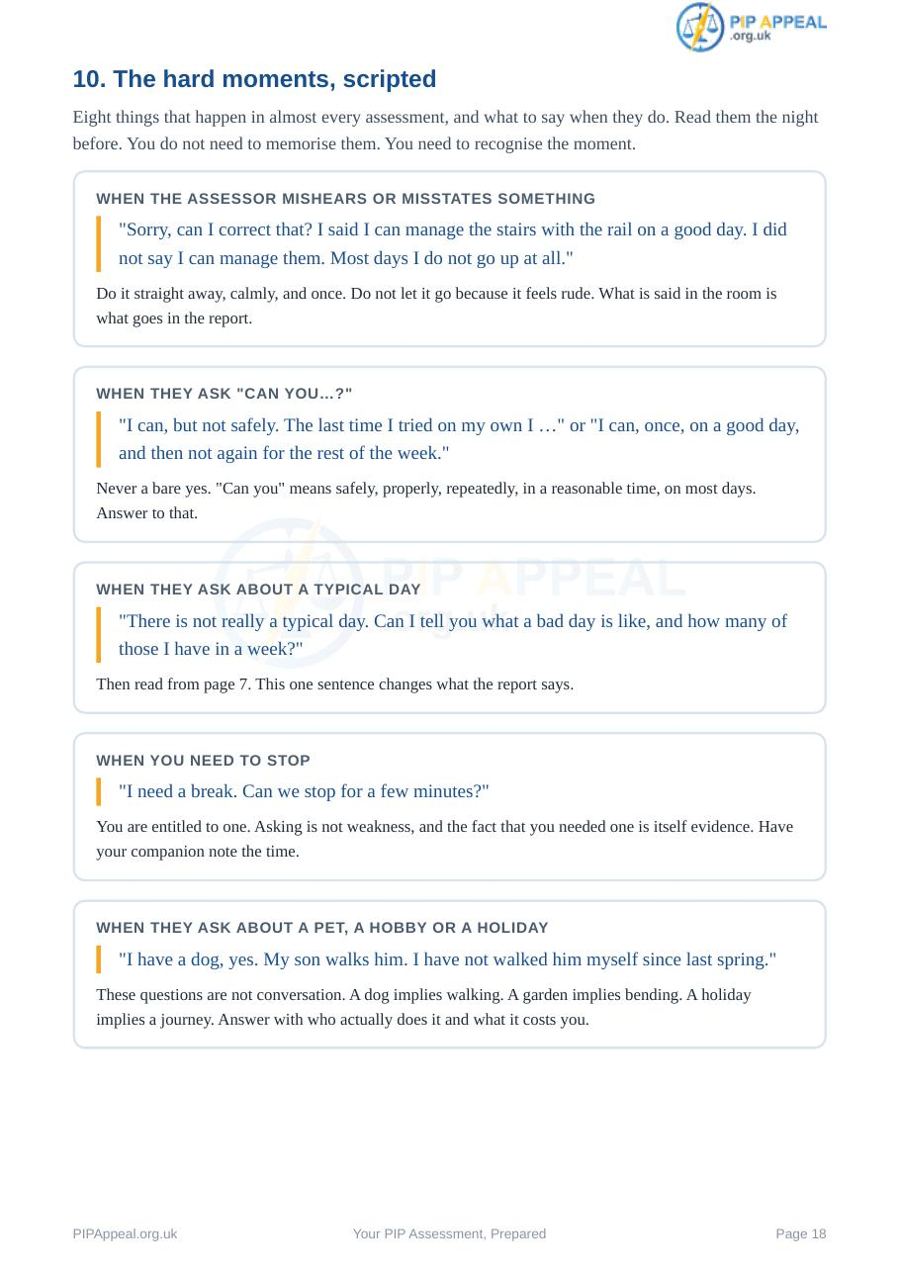
Your PIP workbook, page by page.
Twenty-eight pages to fill in before, use during, and check after your assessment.
PIP Assessment Preparation Workbook
28-page PDF · emailed straight after you order
£12
One-off · PDF
Re: Your PIP workbook — what’s inside.
- Part one: before — what the assessment is really for, the four-part answer, your conditions and medication, and your day honestly: a bad day, a good day, and how many of each.
- Twelve activity worksheets — each with what the activity means, the trap that catches people, and a box for your answer.
- Your three worst-day examples — real incidents with dates, because the assessor has to record a specific fact.
- A page for the person who comes with you — plus the week before, including your right to record the assessment.
- Part two: during — what the assessor is watching, the eight hard moments scripted, the summary at the end, and a record sheet.
- Part three: after — getting your PA4, the report decoded, the eight common errors, your error log, and pages for physical, mental health, fluctuating and cognitive conditions.
What happens next: secure card payment → your workbook arrives by email as a PDF → print it, or type into it on screen. Ordering PIP2 or AR1 form help too? Add the workbook at checkout.
Three steps to a prepared assessment. One appointment that decides your points.
£12 in. Your own notes, ready for the day.
Order the workbook
£12, sent by email
Fill in the worksheets
One activity at a time
Take it to your assessment
Then check the report after
PIP is paid at a standard or enhanced rate for each part. The assessment decides which.
Enhanced rate for both parts = £194.60 a week from April 2026.
£10,120+
Annual award · enhanced
Three ways to prepare for a PIP assessment. Pick the one that fits.
You can prepare on your own, or with a free adviser if you can get an appointment. The workbook gives you a structure for every activity, for £12.
Prepare on your own
Free
+ your time
Your memory on the day
- No upfront cost
- No guide to how each activity is scored
- Written while tired and unwell
- Easy to describe your better days
Best if: you know the PIP descriptors well and have notes from your PIP2 already.
Citizens Advice or Welfare Rights
Free
if you can get an appointment
Help in person or by phone
- Free, independent advice
- Availability varies by area
- Appointments may not fit before your assessment
- You may still prepare the detail yourself
Best if: there’s a service near you with time before your assessment.
PIP workbook
£12
One-off · PDF by email
A worksheet for every activity
- Twelve worksheets, written from the PIP rules
- The hard moments, scripted in advance
- The summary at the end, and how to correct it
- The PA4 decoded, with an error log
Best if: you want to go in with your own notes for every activity, for one small fee.
Get the PIP Workbook — £12Is this workbook for you?
An honest check, so you buy the right thing.
It’s for you if
- Your PIP assessment letter has arrived, or you’re waiting for it
- You find it hard to explain your bad days on the spot
- Your condition fluctuates, or is mental health, cognitive or neurodivergent: there’s a page for each
- Someone is coming with you and wants to help
Something else may suit you better if
- You’ve already had your decision and want to challenge it: see the free PIP preview or a PIP reconsideration letter
- You still need to fill in the PIP2: see PIP2 form help, and add the workbook at checkout
- Your award is being reviewed: see AR1 review form answers

 Long COVID & Chronic Fatigue
“DWP conceded two weeks after my submission was filed. Never even had to go to the hearing. Enhanced rate on both components — I had no idea the written submission could do that.”
 Fibromyalgia & Depression
“After two failed MRs writing my own letters, I used PIPAppeal for my tribunal. The submission was completely different in tone and structure. Won on the day. Got 18 months of backpay.”
 Bipolar Disorder & Mobility Issues
“I was terrified about going. But the submission had laid everything out so clearly that when the panel asked questions, I just had to confirm what was already written. It felt like they were on my side.”

Meet Neil.
A former DWP decision maker who spent 15 years on the inside. Now he writes the letters that overturn refusals.
Inside the DWP
Welfare benefits decision making
Knows the criteria
Trained in current PIP assessment law
Personally reviewed
No letter goes out without his sign-off
Drafted by his team
Across MR and tribunal appeals since 2020
Don’t go in unprepared. Take your own notes.
The PIP Assessment Preparation Workbook. 28 pages, twelve worksheets, £12, sent by email.
Your PIP assessment, prepared.
- Twelve worksheets, one per activity.
- The hard moments, scripted.
- Your worst-day examples, with dates.
- The PA4 report decoded.
- An error log for anything it gets wrong.
What happens after your assessment.
The assessor writes a report, then a DWP decision maker decides. Two ways it usually goes.
You’re awarded PIP
Your decision letter shows your points and your rate for each part, daily living and mobility.
You’re refused, or given too little
You can ask the DWP to look again, normally within one month of your decision letter. See how we’d argue your case with a free PIP preview first.
Still to send your PIP2? PIP2 form help writes every answer for you. Being reviewed instead? See AR1 review form answers. You can add this workbook at checkout with either, or see all our services.
Questions about the PIP assessment workbook.
If your question isn’t covered, email us at support@pipappeal.org.uk and we’ll reply same day.
Twenty-eight pages in three parts. Before: what the assessment is really for, the four-part answer, your day honestly, twelve activity worksheets, your three worst-day examples, a page for the person who comes with you, and the week before. During: what the assessor watches, the hard moments scripted, the summary at the end, and a record sheet. After: getting your PA4, the report decoded, the eight common errors and your error log. Then four pages for physical, mental health, fluctuating and cognitive conditions.
It’s a PDF, sent by email straight after you order. Print it and write on it, or type into the boxes on screen. It’s yours to keep.
As soon as your appointment letter arrives. Fill it in over a week or so, twenty minutes at a time if you need to. Each worksheet stands on its own, so you can do one and come back tomorrow.
Yes. Keep the workbook beside you during a phone or video assessment, and take it with you to a face-to-face one.
Yes. For a phone assessment, tell the assessor at the start that you are recording. For a face-to-face assessment, tell the provider in advance. The workbook explains how, in the week before section.
PIP2 form help writes your answers to the form. The workbook prepares you for the assessment that follows. Many people use both, and you can add the workbook at checkout when you order PIP2 or AR1 form help.
£12, once. There’s nothing else to pay.
The after section helps you get your PA4 report and check what the assessor wrote. If you’ve been refused or given too little, see how we’d argue your case with a free PIP preview.
Yes, to a face-to-face assessment and on a phone or video call. The workbook has a page written for them: what to do before, during and after, and a signal to agree for when you say you’re fine and you’re not. GOV.UK has more on claiming PIP.
Yes. If you have a Work Capability Assessment instead, see the WCA Assessment Preparation Workbook.
Last reviewed